
4/10/2024 Musing from Regina 🦋
Thoughts on the AES Spring Conference on Repair, Shimmers, Rassanblaj, & Homegoing

I write these to share my insights with you more consistently and intentionally. If you want to work with me or learn more about what I’m up to you can visit this page.
This is my collection of things I’ve been collecting on my recent adventures. I’ve been surrounded by people interested in meaning and meaning making and I suppose this is part of my contribution to that effort. You’ll find some translations, a dash of puzzle pieces, and a collage of overlapping timelines. I’ve been in Pittsburgh, PA, under a total solar eclipse, and in the Blue Ridge Mountains.
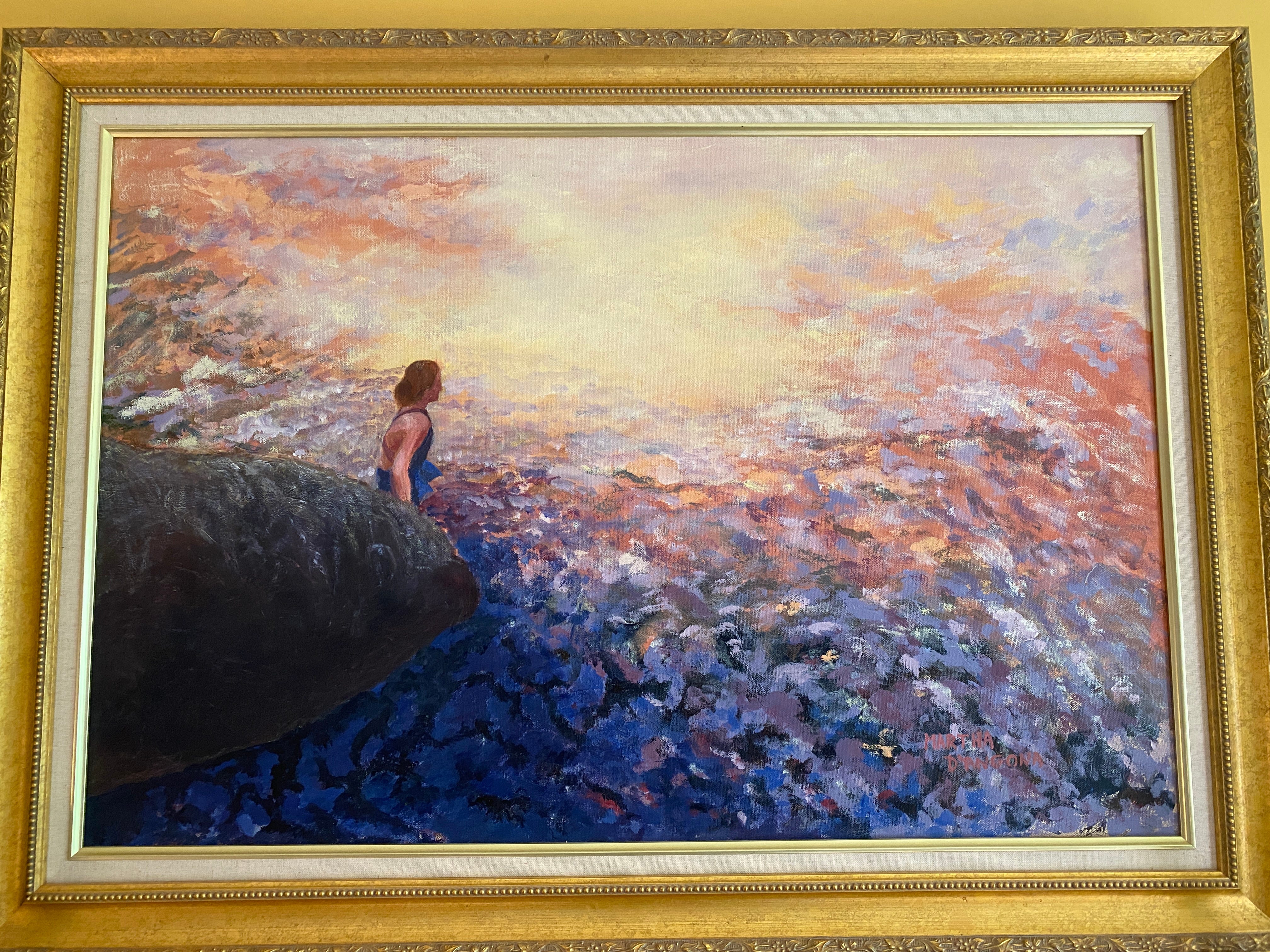
What Will Tomorrow Be Acrylic on Canvas by Martha D’Angona (my great aunt by marriage)
I pay attention to the things that shimmer. For me, this is an intuitive practice where I get present, observe, and take note of when something grabs my attention and I feel an internal *ping* of recognition. That’s a thing that shimmers. Think about how the sunlight catches the water or a small piece of a mirror unexpectedly reflects light in the summer. That is what noticing shimmering things is like for me be it people, places, symbols, or ideas. Listen to this audio for a summary of the pieces that have shimmered softly in my recent experience (and/or if you don’t have time to read this whole piece).
Words that Shimmer Softly Early April 2024 Recording:
In the spring of 2019 I wrote the question: how does an expanded self return? This inquiry was about returning after studying abroad and wondering about what to do when you find that the life you were living is now too small. I had left Pittsburgh, lived in India, and then came back; an experience that ushered me into an intensely sharp depression. I write: “Coupled with this great eye lifting, shoulder opening, arm outstretching expansion was a sharp fetal curling, deep shattering, and pointed contraction into myself upon my return.” It was this experience that first introduced me to depression in the deepest ways.
In the spring of 2020, I abruptly moved from Pittsburgh back to Wyoming to quarantine with my mother, sisters, and partner. I left Pittsburgh, and it wasn’t until this week (four years later, almost exactly) that I found myself back on campus. I was a new self returning to old places. And expanded self returning. And not just any old places, but an old home.
I came back to Pittsburgh this time for the American Ethnographic Society’s Spring Conference Entitled Repair (you can read more about it here.) The invitation was for scholars to grapple with the complexities and possibilities of repair in the contexts of the people and sites with and in which they work.
I was specifically struck by how it felt to be in a room full of people who are doing what I could have done: they were PhD’s & Professional Scholars who have written ethnographies. They are doing what I thought I would do when I graduated. And now I was present with so many people embodying my parallel life, and I was grateful to have one foot in that world and one foot out. I found new appreciation for my work with Wellspring and for the ways I have chosen to not just do the research but apply it. In the following you’ll find my summary from the conference panels and the pieces I am taking with me.
Rassanblaj & Being Permanently Ready for the Marvelous
One of the first shimmers of the conference happened when Gina Athena Ulysse stood at the invocation and said, “Being prepared is not how you get ready for this.” It reminded me of Kasia Urbaniak talking about how she doesn’t have to know or understand everything, she just has to be aware. Being ready isn’t a brain thing. It’s a being thing. Watching Gina Athena stand in front of a room of academics and sing, perform poetry, and present scholarship was a welcome home moment for me - I saw more of what I want to be and to help people be. In this first panel of the conference, I heard pieces of going beyond diagnosis, who can afford to slow down, deviance and dysfunction and distress, societal problems being housed on the individual, and having a word for healing not an object but a relationship - a word that also has spiritual and magical resonance.
Gina Athena is an artist scholar. (You can watch her TEDx Talk here.) She is someone holding the tension of seemingly separate worlds (creativity and anthropology) and living the questions of how to weave them together. In Gina I saw another embodiment of the visionary, the creative, the wise. I am leaning on the world I see her and Kim Krans building, the one I too am part of and I am delighted.
Alongside Arlene Torres, Gina Athena led a workshop on Rassanblaj - a Haitian Creole word that means "reassembly" or "regrouping.” In this workshop, Arlene and Gina spoke of their lived experience at the border zone of the arts and ethnography. Gina uses rassanblaj as a practice. For her, it is about collecting the pieces, the people, the things, the spirits, gathering the components of the project, and holding them together. For her, it is about regathering ourselves as a move towards wholeness. She talked about how an intellectual or dispassionate analysis feels insufficient and how what is creative feels organic. Having the creative and the scholarly together feels more natural and more coherent. Standing in this coherence is how Gina is able to be permanently ready for the marvelous.
In addition to rassanblaj, Arlene spoke of a Bruja Epistemology - a theory of knowledge, a genealogy, of healing women and wise and magical legacies. An alternative to colonial, patriarchal, and dominant narratives. She talked about the ways how, where, and why are mixed together. In this space I moved towards knowing how to show people the way to engage with my creativity. I was given access to a lineage of people who have done and are doing what I am doing by bringing (reassembling) pieces of anthropology, neuroscience, spirituality, collage, and depression together. I went from feeling like a lone wolf to finding a pack. Arlene & Gina mentioned: Brenda Cardenas, Faye Harrison, Catharine Dunham, & Julian Steward.
I find many pieces of my constellation fit into this bruja epistemology: Sue Monk Kidd, Kim Krans, Sharon Blackie, Maureen Murdock, Krista Tippett, Brené Brown, Chimamanda Ngoni Adichie, Carolyn Lovewell, Kasia Urbaniak, and Ann Lamott. I am excited to see what projects I will be adding to this library.
The pieces you’ll find below are more shimmers I collected from the Repair Conference’s various panels.
Asperities of Care
I learned that “asperity” means rough edges, and in the panel exploring the rough edges of care I learned about wound narratives, tying knots of intimacy, resurgent care, and speaking the body out.
Foroogh Farhang talked about caring as a way to go on after war, how gardening and a daily act of reciprocity were vital for the wife of the Syrian cemetery caregiver: she beautified a contested area and is so doing connected the lives of the living and the dead.
Annikki Herranen-Tabibi asked: when distress comes is there time to think about beautiful things? In her research studying the melting of the permafost and the collapsing cryoshpere in the northernmost Finnish-Norweigan border she looks at the idea of resurgent care and the possibility everyday acts of care have to repair, the ways care and suffering are woven, and the intimate labors of care.
Omar Al-Dewachi spoke of care beyond the physical mending of wounds, how the narrative of the wound or injury are imbued with larger meanings and are a tool for understanding violence. He shared how these narratives shape our sense of self and our understanding of the world.
Aalyia Sadruddin studies late life worlds in Rwanda and noticed how the practice of caregiving teaches us what is most important and reveals the heart of being human. Her interlocutors showed her the practice of speaking the body out, speaking to the body, and how repair can be subtle and facilitate calm dignity.
Technologies of Repair
Zachary Sheldon talked about designed depth, of transitive repair vs transcendental repair and how we must repair to a deeper reality. He talked about getting to the something else, a depth ontology and a flat ontology.
This was one of my favorite presentations. Zach showed how we have both inner and outer senses and have a stereoscopic view and are able to exist and see both states. He asked how does someone with inherent depth come to believe that they are flat? I was intrigued with how he was able to demonstrate the ways people who are creating technology are interacting with the process of creation as a way of accessing what is beyond or what is possible but not yet real. The desire to understand the way the world works is accessed by understanding the mechanism. He talked about how a model is what is beyond a metaphor, and how power is the ability to see below the surface. He also talked about agency and autonomy - something I need to follow up with him about and learn more.
Hazel Corak talked about invisible compositions (bread, metal, people), selves in the making, alterity affirming statements, & forms of virtue. Stephanie Love wove this panel together with comments about the visibility of infrastructure and interiority (what am I made of?), challenging the dominance of vision with the ear, the mystery of depth, and the act of witnessing. She wondered about who is present to who and how the act of listening can be subversive, and how the point is the mystery beyond.
The question of a being with depth coming to believe they are flat stuck with me - I think this is what we experience as depression. This deep disconnect with things about our nature and what worlds and mysteries we have access to.
Later in the day Jovan Scott Lewis talked about images that give us a glimpse of life (specifically black life) outside of injury and beyond a framework of repair, a terrain in which you can remain yourself and a domain in which something that hasn’t been before can emerge: something beyond reparations, resilience, and repair. Something more whole.
Paranoid and Reparative Readings of Psychotherapeutic Interventions
This panel felt like it was made for me: first with research in the Himalayas about mental health, then with research about the business of repairing others, then with an anthropologist / psychotherapist, who is also the child of divorced parents, seeking to understand the separation between the two fields and why they don’t get along. All to be summed up with a summary of how we need to move from the macro worlds and into the intimacy.
Aidan Seale Feldman talked about the intersubjective otherwise that emerges in the contours of the therapeutic interaction and the forms of care and words that curate forms of intimacy or distance and formality. She saw how listening can be a way to cement the human bond. She was looking at offering temporary psychological care after an earthquake in the Himalayas and the ethics of only being able to help for a short while. She was also asking questions of when care and compassion can become harmful and even violent - medical imperialism and the challenges of making anthropology immediately useful. She noted how management of mental health has become biopolitical.
Nicholas Long studied the hypnotherapy business in Java and offered a reading of therapeutic entrepreneurship and what he calls the hypno-hustle (yes, I felt seen in many ways). He talked about holding the unreliability of the business and how overextension occurs for personal and systemic reasons. He shared the story of two brothers, one of whom wanted to heal his brother but couldn’t do so directly and so invited him into the business.
Sean Dowdy shared how he inhabits a dual identity as anthropologist and psychotherapist with a split subjectivity. He reflected how his interest in attending to splits and ruptures in his work connects to his identity as a child of divorce. He talked about how anthropology and psychology don’t really get along and he wanted to know why. He shared Melanie Kleins framework of mock reparations vs true reparations and omnipotent defenses such as control, triumph, and contempt. He shared that anthropology and psychology meet where individual processes are also happening on larger levels (when you realize what you are going through is structural). He called for fields of study being able to tolerate the harm of their history.
Britt Krause tied these papers together by talking about how psychoanalysis is a very wide concept with vast differences. She commented on the ways the institutionalization of psychotherapy is separate from the practice of it in many ways and the connection between anthropology and psychology happens on the ground in real experiences. She asked about what work the relationship does and shared how people are amalgams of many different positions (what is encapsulated in your personhood?)
We See Us with The Language Attitude Institute
This next panel was experiential and I LOVED getting to connect with Tina & Veronica. From their website: The Language Attitude Institute advocates for cultural and linguistic human rights by designing interactive arts experiences to explore the impact of culture and language on lives, relationships and knowledges.
We explored how to weave harmonious and integrous relationships with self, environment, and people. Specifically, we looked at the the bóg card game and the Rooted Colored project which is an ethnographic project using listening, dialogue, spirituality, and art to explore identity and healing. (Anybody else seeing lots of connections to Wellspring?)
Repairing the Irreparable
This panel helped me to think more about going beyond the binary of wound and repair, and how to hold the things that cannot be fixed.
Alexandra Dantzer shared her research with the sleepless - people with insomnia. She talked about pathologizing sleep and “hacking” sleep. The difference between “knowable” and “doable.” The looping experience of insomnia and sleep, the spiral of how something feels so important and further and further away. The problems that arise once we’re in the optimization zone and managing the experience.
Zachary Sheldon (his second presentation I attended) shared about insight and moments of perception that happen when people run into sharp edges - the moments that make us want to understand the mechanisms below. He talked about content and form, curiosity and conspiracy theories, imaginative experiments, and the sources of where we understand ourselves.
Roseanne Johnson explored what it means to be an artist in the US. She shared how artists engage with themselves as a piece in constant flux. She shared how art and artists are slippery and mobile concepts, how the artist in an art object, and how artists relate to making. She commented on the exclusivity and boundaries of who is and is not an artist.
Tanzeen Doha shared about tearfulness - and how tearfulness is fundamental to the ethical. He uses ethnography as a comparative study of concepts in a way that goes beyond the intellectual and brings the emotional and actual along with it.
Darléne Dubuisson tied these papers together by talking about the naming that seems to do more than name, the perception of the interior, and the fantastic that is knowable.
Homegoing
Although I haven’t yet read it, throughout this trip Yaa Gyasi's novel Homegoing has been in my possession. I think I am carrying it for the word in its title, which for me has been about occupying a place, going to a place, that holds pieces of who I am now although it isn’t my home anymore. According to Google’s AI search, Homegoing is a Christian funeral tradition in the African American community that celebrates the deceased's release from life and reunion with God. The service is not somber, but rather focuses on celebrating the life and entrance into heaven. After the service, friends and family typically gather at a reception or re-past to share stories and memories.
I suppose my home going to Pittsburgh is a funeral in a way. It was an acknowledgment of alternate lives that I did not choose to live and so have died in some ways. And it was celebratory. Driving through the Fort Pitt Tunnel with the windows down, sun roof open, Hozier’s Damage Gets Done playing on the radio and the city appearing before me was euphoric.